Is It Time to Sell Micron Stock Despite Record Revenue?
Despite reporting record revenue and strong artificial intelligence demand, Micron Technology faces growing concerns over NAND prices and market volatility, leaving long-term investors weighing whether to sell their shares.


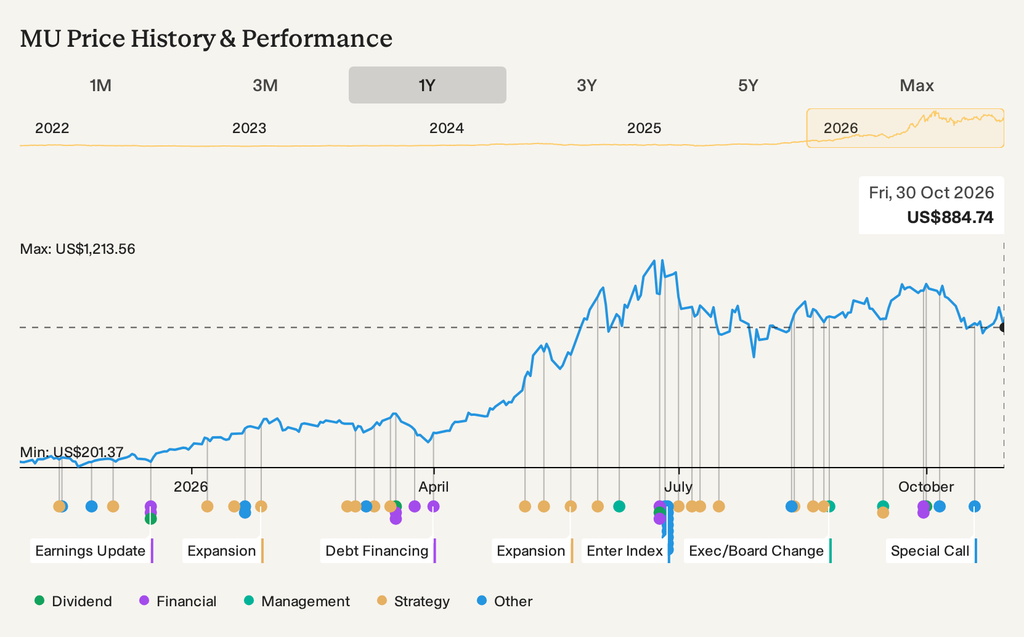
Is it time to sell MU stock? For the majority of long-term investors, the recommendation remains negative—at least for now. Micron reported a record-breaking $54.23 billion in revenue for the fourth quarter of fiscal 2026, alongside projections for constrained memory supply extending through 2028. Nonetheless, genuine risks persist regarding Micron NAND prices, driven by Kioxia’s cautions regarding decelerating price growth and ongoing debates surrounding artificial intelligence expenditure. At present, MU stock changes hands at $884.74, and prevailing Micron stock forecasts from analysts generally lean upward, albeit accompanied by caution.
Also Read: 5 Wall Street Firms Cut Google Stock Price Target After Crash
Micron Stock Outlook: NAND Prices, AI Spending And Earnings
Currently, MU stock trades roughly 27% below its 12-month peak of $1,213.56, while remaining up approximately 339% relative to its trough of $201.37. This substantial volatility prompts many shareholders to wonder whether they should sell MU stock to lock in profits. The movement is mapped out below.
Record Micron Earnings And An Even Stronger Outlook
For the entirety of fiscal 2026, Micron generated $133.19 billion in revenue and offered guidance for roughly $61.5 billion in revenue for the first quarter of fiscal 2027 (plus or minus $1.5 billion). Furthermore, long-term supply agreements account for over 35% of revenue through 2030.
Sanjay Mehrotra, CEO and Chairman of Micron Technology, stated:
“Micron delivered record fiscal 2026 results, and we expect an even stronger fiscal 2027. AI is becoming Super Intelligence (SI), and memory enhances this intelligence and the competitiveness of our customers’ platforms. We are increasing our investments in technology, products and manufacturing to help drive SI forward with our customers, and our Strategic Customer Agreements provide added confidence in the durability of Micron’s financial performance.”
These binding contracts offer the most robust counterweight for individuals debating whether to liquidate MU stock ahead of a potential market cycle shift.
Micron NAND Prices Slow As AI Spending Gets Tested
Current market pressures originate primarily from industry competitors. While SK Hynix emphasized ongoing tightness in memory markets, Kioxia issued warnings regarding slower appreciation for NAND prices, and Intel highlighted elevated memory expenditures. This conflicting data explains why inquiries about selling MU stock have surged.
Any softening in Micron NAND prices would arrive at a challenging juncture given Micron’s heavy capital expenditure commitments. A broader contraction in AI capital spending, combined with aggressive price reductions from competitors like SK Hynix, Samsung, or Kioxia, would directly impact that contracted revenue base. While this market noise has not yet altered Micron’s internal demand projections, a continued cooling of Micron NAND prices into 2027 could quickly alter the calculus for investors considering whether to sell.
Should I Sell MU Stock? What The Micron Stock Forecast Says
The primary Micron stock forecast monitored by Simply Wall St projects $320.4 billion in revenue and $217.9 billion in earnings by the year 2029. Based on these figures, fair value is estimated at roughly 76% above current trading levels. Conversely, more conservative analysts anticipate revenues near $236.3 billion alongside $207.2 billion in earnings, yielding a price-to-earnings ratio of approximately 6x. An evaluation incorporating 28 alternative fair value models even points toward a potential 38% downside. For anyone weighing whether to sell MU stock, this analytical divergence represents the critical metric to monitor.
Also Read: Nvidia Stock Falls as Chip Index Sinks 6.8% on AI Spending Fears
Ultimately, deciding whether to sell MU stock depends on individual conviction: those who believe AI demand will sustain memory scarcity find justification in current contracts and corporate guidance. Conversely, investors who bought near the $1,213 high and want to mitigate exposure to sharp corrections may find that trimming a portion of their holdings is a sensible compromise. With MU stock resting well below its previous peaks, upcoming financial results and forthcoming NAND pricing metrics will ultimately determine which perspective proves correct.
Frequently Asked Questions
What was Micron’s revenue for Q4 fiscal 2026?
Micron recorded a record $54.23 billion in revenue for the fourth quarter of fiscal 2026, bringing its total revenue for the full fiscal year to $133.19 billion.
What are analysts predicting for Micron’s future financial performance?
The primary stock forecast tracks projections of $320.4 billion in revenue and $217.9 billion in earnings by 2029, suggesting fair value could be roughly 76% higher than current trading levels, though more cautious projections exist.
Why are investors concerned about NAND prices?
Concerns arose after Kioxia warned of slower price gains for NAND memory, and Intel pointed to high memory costs, creating conflicting signals alongside rising capital expenditures and questions over AI spending.