Musk Loses $48.5B Following 40% Drop in SpaceX Value
Elon Musk lost over $48.5 billion after SpaceX stock dropped 40% from its post-IPO peak to $134.72, driven by AI bubble anxieties, a massive $40 billion chip lease agreement, and broader market sell-offs.

Elon Musk experienced a net worth reduction exceeding $48.5 billion on Friday, bringing his total down to $865 billion based on Bloomberg statistics. This drop stemmed from a SpaceX share price decrease to $134.72—roughly 40% beneath its post-IPO peak—amidst mounting AI bubble anxieties and a broader United States market sell-off. Anyone reviewing SpaceX stock today will observe it at its minimum point since August, occurring just weeks following Musk’s return to trillionaire status.
Also Read: Should I Sell MU Stock as NAND Prices Slow Despite Record Revenue?
SpaceX Stock Decline Raises AI Bubble Fears as Musk’s Wealth Falls
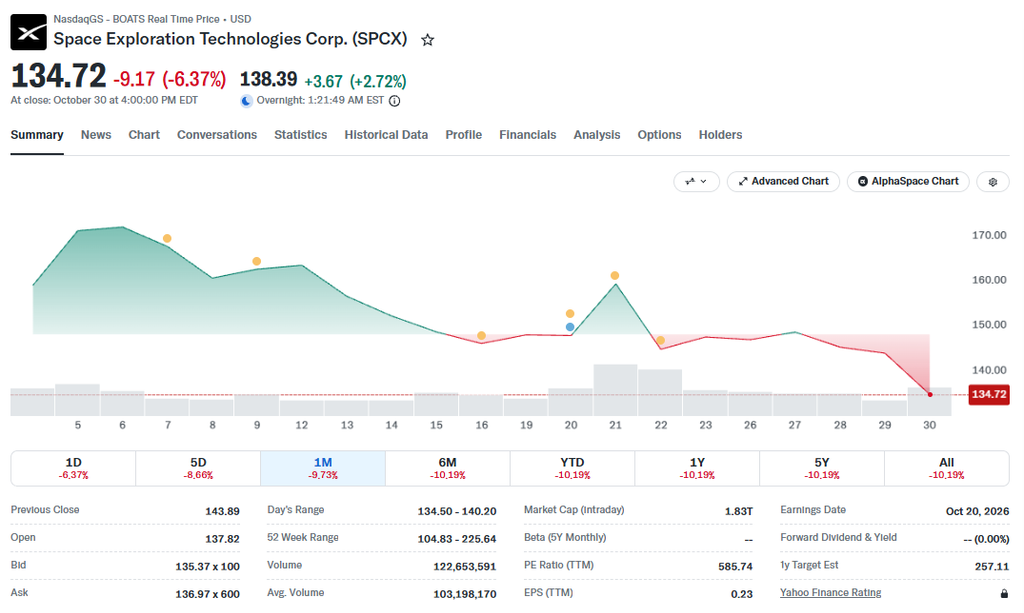
SpaceX began trading on the Nasdaq under the SPCX ticker on June 12, 2026, at an initial price of $135 per share, subsequently reaching an all-time high of $225.64 four days later. Shares briefly rebounded to $176.56 last month before another descent commenced. This rapid fluctuation accounts for the severity of Musk’s wealth reduction.
Source: Yahoo Finance
Presently, current evaluations of SpaceX stock show the equity trading slightly beneath its IPO valuation. The stock shed $9.17, amounting to 6.37%, on Friday alone, pushing its monthly losses to 9.73%. Musk’s financial decline tracks this performance closely, given that the bulk of his capital is tied up in SpaceX.
The $40 Billion Lease That Spooked The Market
On October 26, SpaceX revealed an agreement valued at approximately $40 billion with an enterprise managed by Apollo Global Management. Under the arrangement, this entity will acquire Nvidia’s upcoming Vera Rubin chips and lease them back to SpaceX over a five-year timeframe commencing in 2027. Musk’s wealth drop accelerated following the announcement of this transaction.
Chief Financial Officer Bret Johnsen commented:
“This lease diversifies our funding sources and addresses a notable portion of the funding required to deliver on our growth plans.”
Furthermore, he projected capital expenditures for the fourth quarter to range between $35 billion and $40 billion, marking an increase from the $19.6 billion recorded in the third quarter.
AI Revenue Beats Starlink, But The Bill Keeps Growing
Financial results released on October 20 appeared robust initially. Aggregate revenue climbed 161% to reach $14.58 billion, with AI-related revenue hitting $7.56 billion to outperform Starlink’s $5.24 billion. Concurrently, the artificial intelligence division expended $16.4 billion—surpassing the combined spending of the space and connectivity divisions—with these high expenses serving as a primary driver of Musk’s financial downturn.
Musk himself addressed vulnerabilities among smaller cloud computing entities, sharing the following perspective on X:
“As of the past few weeks, debt markets have almost entirely shut off access to money for any company that doesn’t have substantial revenue independent of AI data centers.”
He continued:
“That means the 200+ neoclods are going to see guppy-level death and consolidation. Some will make it through, but not many.”
Industry counterparts including CoreWeave, Nebius, and IREN have each surrendered greater than 50% of their value from historic peaks, contributing to sector-wide distress that fuels both AI bubble concerns and Musk’s personal wealth contraction.
Also Read: 5 Wall Street Firms Cut Google Stock Price Target After Crash
Tesla Merger Talk Softens Musk’s Fortune Decline
Conversely, Tesla provided some financial cushioning by closing the week at $400 after Musk acknowledged he is evaluating a potential consolidation of the two enterprises. Dan Ives from Yorkville Ives estimates the probability of such an agreement concluding by the close of 2027 at 80% to 90%. Because Musk retains roughly a 49% ownership stake in SpaceX, each downward movement in SpaceX stock affects Elon Musk’s net worth much more severely than his approximate 12% stake in Tesla can mitigate.
At present, the trajectory of Musk’s net worth hinges on whether the artificial intelligence market establishes a stable base. Subsequent declines in SpaceX stock would pull Elon Musk’s net worth downward once more, while broader AI bubble worries will likely determine if current SpaceX valuations represent a definitive floor once the $35 billion to $40 billion investment strategy begins yielding tangible results.
Frequently Asked Questions
Why did Elon Musk’s net worth drop significantly?
Musk’s net worth fell due to a 40% drop in SpaceX stock from its post-IPO peak, which led to a single-day wealth loss of more than $48.5 billion amid wider AI bubble fears and a US market sell-off.
How much is SpaceX stock currently trading for?
SpaceX stock dropped to $134.72 per share, falling just under its initial IPO price of $135 and marking its lowest level since August.
What caused the recent market spook regarding SpaceX?
SpaceX disclosed a roughly $40 billion lease agreement with an Apollo Global Management-run entity to buy and lease Nvidia Vera Rubin chips, alongside fourth-quarter capital spending projections of $35 billion to $40 billion.
How do Tesla shares affect Musk’s overall wealth during this downturn?
Tesla shares provided some relief by closing the week at $400 amid talks of a potential merger between Tesla and SpaceX, though Musk’s 49% stake in SpaceX means its drop impacts his net worth far more than his 12% Tesla stake can offset.